Your production is running at full speed—and suddenly the cooling system breaks down. Or a new project requires a specialized refrigeration system that you can’t purchase right away. In both situations, rental refrigeration is the solution that many industrial companies today wouldn’t want to be without.
But what exactly does the term mean? When is it really worth renting a refrigeration system? And what does the process actually involve? This guide answers all the basic questions.
| Here’s what you can expect in this article: |
| ✔ Definition: What is rental cooling, and how does it differ from standard cooling? |
| ✔ Typical use cases: When do businesses choose to rent instead of buy? |
| ✔ What types of systems are available? — Chillers, cryogenic systems, container units, air handlers |
| ✔ Renting vs. Buying: An Honest Comparison |
| ✔ Step-by-step: Here’s how renting with SOS-Rentals works |
| ✔ Frequently Asked Questions (FAQ) |
What is “rented cooling”? The definition
Rental cooling refers to the short-term or project-based rental of industrial
refrigeration systems. Instead of purchasing and maintaining an expensive system, a company rents a mobile, ready-to-use chiller for a specified period—including delivery, commissioning, and maintenance.
The term encompasses a wide range of products: from air-cooled chillers for standard temperatures to low-temperature systems
capable of reaching -80 °C, as well as HACCP-compliant refrigerated containers and air handlers for climate control in industrial buildings.
When do businesses rent refrigeration equipment? The 5 most common reasons
In practice, rental cooling is used in five typical situations:
Emergency cooling in the event of a system failure
The most common and urgent scenario: Your own cooling system fails. In food production, the pharmaceutical industry, or data centers, this can lead to critical damage within hours. An immediately available rental cooling system bridges the gap until repairs are completed—often available for delivery the same day or the next.
Seasonal peak loads in the summer
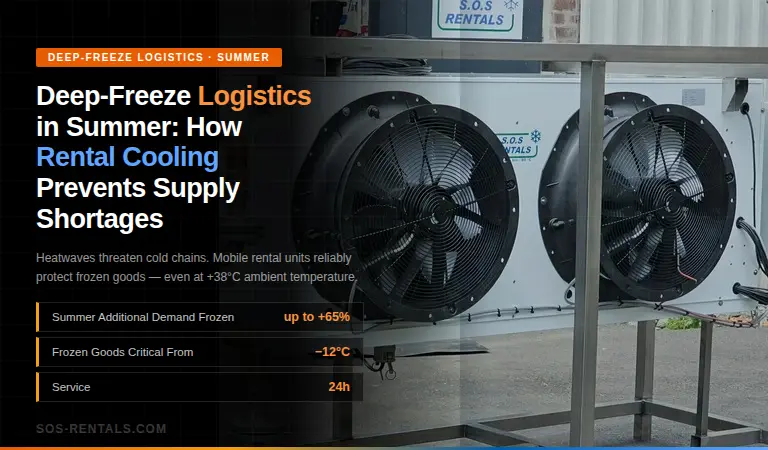
During the summer, cooling demand rises sharply in many industries. Existing systems are operating at full capacity. Instead of making long-term investments in new capacity, businesses rent temporary support for the peak season—a cost-effective solution with no long-term commitment.
Scheduled maintenance and inspections
If your own system needs to be shut down for maintenance, overhaul, or component replacement, a rental refrigeration system ensures that operations continue seamlessly. No production downtime, no delivery issues.
Project-based cooling
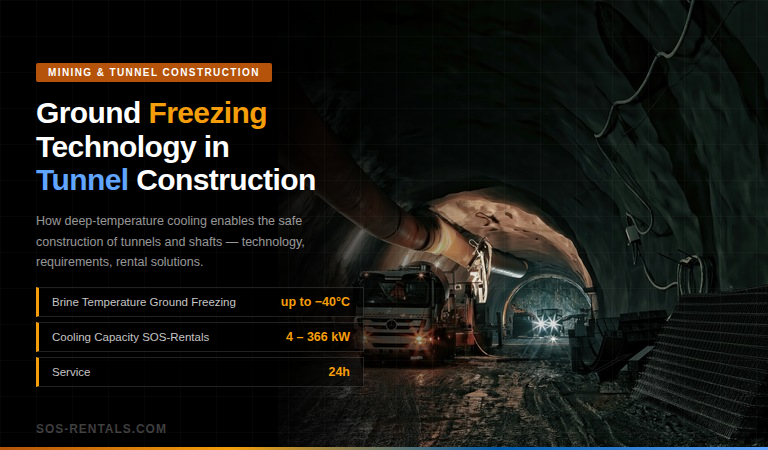
Construction projects, tunnel work (ground freezing), plant installations, or temporary increases in production require cooling capacity for a limited period of time. Purchasing a system would be uneconomical in these cases.
Test and pilot applications
New processes should be tested first before investing in permanent infrastructure. By renting cooling units, businesses can test temperature ranges, performance classes, and configurations—without any risk.
IN STOCK NOW + FAST SHIPPING
Need a cooling system on short notice?
Our team will get back to you within 24 hours—from 4 kW chillers to
low-temperature systems down to -80 °C
What types of rental cooling systems are available?
SOS-Rentals offers four main categories of rental cooling systems:
Chiller (air-cooled) — 4 to 1,000 kW
| Chillers are the most versatile category. They are suitable for process cooling, building air conditioning, data centers, and most industrial applications. Temperatures typically range from +5°C to +15°C. Air-cooled models are easier to install, while water-cooled models offer higher efficiency. |
| Applications: Data centers · Automotive industry · Plastics processing · Building cooling · Events |
Low-temperature systems — down to -80 °C
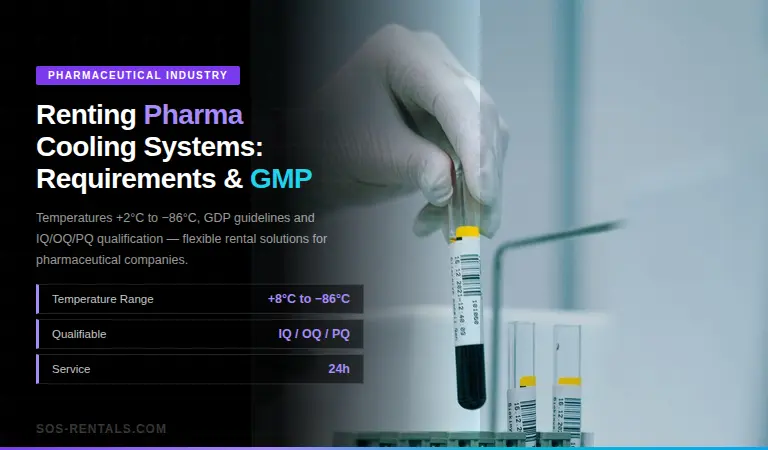
SOS-Rentals’ unique selling point: low-temperature systems for extreme cold conditions. With cooling capacities ranging from 4 to 366 kW at temperatures from -15°C to -80°C. Used in tunnel construction (ground freezing technology), the chemical and pharmaceutical industries, and the food industry. |
Applications: Tunnel construction · Pharmaceuticals · Chemical industry · Frozen food logistics · Research |
Reefer and cryogenic containers — down to -110 °C
HACCP-compliant refrigerated containers for the storage and transport of frozen goods, pharmaceuticals, or chemical substances. Capable of temperatures as low as -110°C and meeting specific pharmaceutical qualifications. |
Applications: Food storage · Pharmaceutical companies · Shipping · Events · Emergency freezing |
Air Handlers / Air Coolers
| Air handlers provide precise climate control and air distribution in industrial buildings, tents, event venues, and temporary structures. They are the perfect complement to chillers for complete climate control solutions. Suitable for standard and cold storage rooms down to -25 °C |
Applications: Events · Industrial facilities · Construction sites · Emergency cooling |
Renting vs. Buying: An Honest Comparison
The key question: When is renting more economical than buying? The answer depends on the specific situation—here is an overview of the most important criteria:
Criterion | Rental cooling | Purchase |
Capital | No acquisition costs | High upfront investment (€50,000–€500,000+) |
Avail- | Ready for | Delivery times: weeks to months |
Flex- | Rental period can be chosen freely | Long-term commitment |
Main- | Can be | In-house maintenance costs + personnel |
Capital formation | No fixed assets have been accumulated | Asset held (book value) |
State | Always up-to-date rental fleet | Deterioration after a few years |
For tax purposes | Business expense | Depreciation over the useful life |
Risk in the event of default | Replace-ment | Out-of-pocket expenses, long delivery times |
Ideal for | Emergency, | Continuous operation, core technology |
Conclusion: Renting cooling capacity is more cost-effective when cooling needs are temporary, unpredictable, or short-term. For ongoing core operations, purchasing equipment may be more cost-effective in the long run. In practice, many companies combine both approaches: meeting base load with owned equipment, and handling peak
and emergency demands with rented cooling capacity.
How SOS-Rentals' rental cooling works: Step by step
The process is simpler than many people expect. It takes just a few steps from the initial inquiry to a fully operational system:
By phone (+49 2933 9836270) or via the form on sos-rentals.com/contact. Please describe your requirements: required cooling capacity (kW), temperature range, time period, and location.
- An SOS Rentals consultant will assess your needs and recommend the right system for you. You’ll receive a detailed quote with all costs included—transparent and with no hidden fees.
- SOS-Rentals will deliver the equipment to your location. If needed, our team will handle installation, connection, and commissioning.
- Throughout the rental period, the SOS Rentals service is available to assist you with any questions or issues. Optional: regular maintenance and inspections included.
- At the end of the rental period, SOS-Rentals will pick up the unit—including the environmentally responsible disposal of refrigerants in accordance with legal requirements
Vorgaben.
Frequently Asked Questions About Rental Coolin (FAQ)
How much does it cost to rent a refrigeration system?
The cost depends heavily on cooling capacity, temperature range, and rental duration. As a general guide, a basic air chiller for medium-capacity applications starts at around €150–300 per day. Low-temperature units and larger systems cost more. SOS-Rentals will provide a customized quote upon request—free of charge and with no obligation.
How quickly can a rental cooling system be delivered?
In emergencies, delivery is often available throughout Germany within 24 hours. If you plan ahead (3–5 business days), we guarantee that the optimal system will be available. SOS-Rentals maintains a large rental fleet of equipment that is ready for immediate use.
Who is responsible for installation and commissioning?
SOS-Rentals handles all aspects of delivery, installation, connection, and commissioning. You do not need your own refrigeration technicians. Optional ongoing remote maintenance is also available during the rental period.
What temperatures can be achieved with rental cooling units?
The range extends from standard process cooling (+15°C to +5°C) to cryogenic temperatures as low as -80°C using specialized systems, and even down to -110°C with cryogenic containers (HACCP-compliant). SOS-Rentals thus covers virtually every industrial refrigeration need.
Conclusion: Rental cooling is the flexible solution for unplanned cooling needs
Rental cooling is much more than just an emergency backup. It is a strategic option for companies that want to combine flexibility, speed, and cost-efficiency without having to invest in capital-intensive infrastructure.
With a rental fleet that includes chillers, low-temperature systems capable of reaching -80°C, HACCP-compliant refrigerated containers, and air handlers, SOS-Rentals offers one of the widest ranges of industrial refrigeration rental equipment in
the German-speaking world.
Whether it’s an emergency, a peak season, a construction project, or a trial run—get in touch with us. We’ll provide you with free, no-obligation advice.
Request a free quote now
Rent refrigeration equipment — fast, flexible, and with no investment risk.
☎ +49 2933 9836270 | info@sos-rentals.de | sos-rentals.com/contact