What is ground freezing technology in tunnel construction?
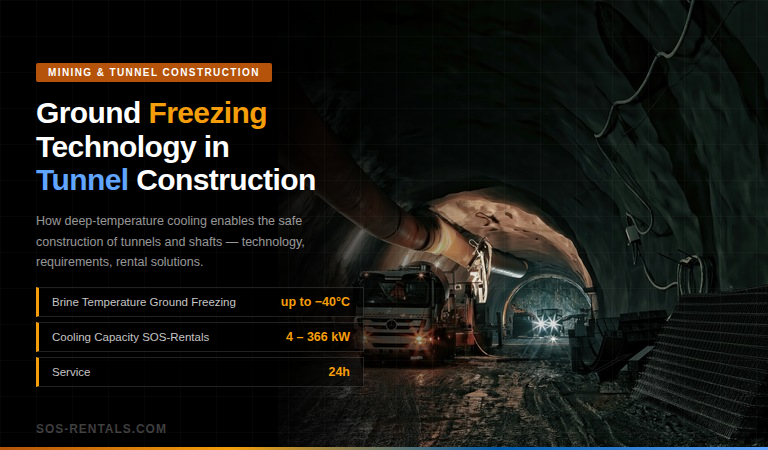
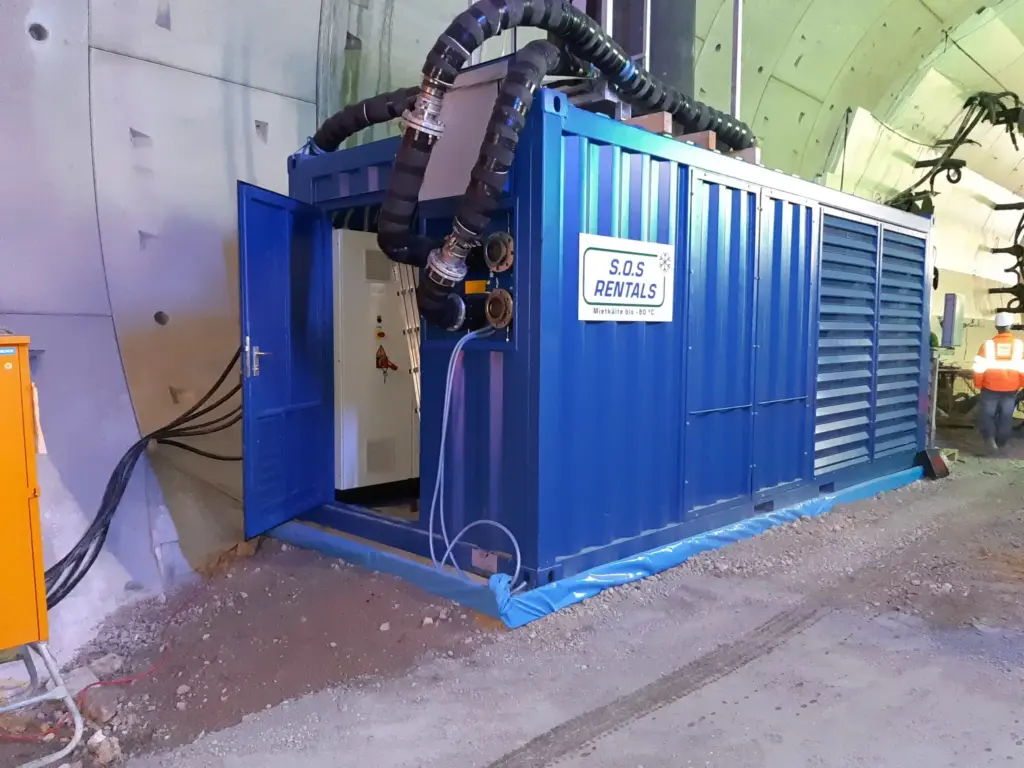
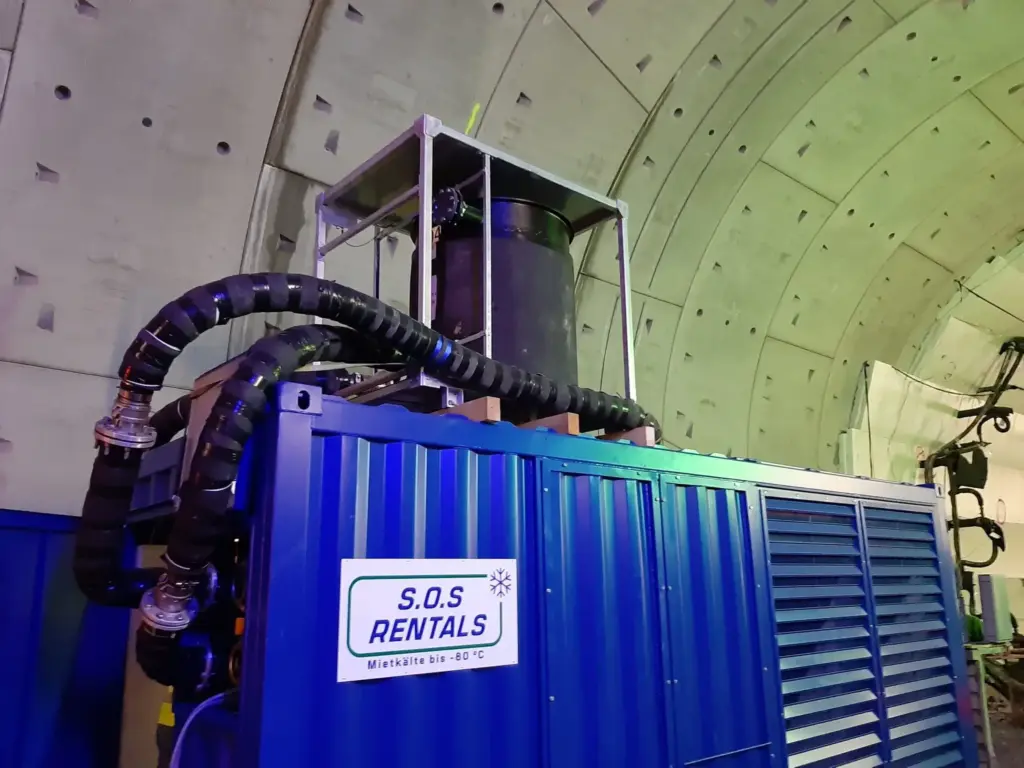
Ground freezing technology (ground freezing) is a process in which the ground is artificially stabilised by freezing the pore water. Chilled brine at temperatures ranging from −25°C to −40°C is circulated through freezing pipes in the ground. The resulting ice dome supports loads, seals against groundwater and enables safe excavation — without the need for conventional shoring structures. Chillers from SOS-Rentals provide the necessary low-temperature capacity of 4 to 366 kW for this purpose.
Frozen food or medicines — for many people, industrial refrigeration is associated with these sectors. It is less well known that refrigeration units are also among the most important pieces of construction equipment in tunnel and shaft construction.
Ground freezing technology makes exactly that possible: it freezes the ground, making it stable and watertight — and thus enables safe excavation even under the most challenging geological conditions.
This article explains how the process works, what refrigeration systems are required, and when renting refrigeration equipment is the more cost-effective option.
Here’s what you can expect from this article: |
✔ How ground freezing works — step by step |
✔ Typical applications: tunnels, shafts, mining |
✔ What temperatures and cooling capacities are required |
✔ An overview of coolants: brine, methanol, nitrogen |
✔ Why renting cooling systems makes more economic sense for construction projects |
✔ What SOS-Rentals delivers — and how quickly |
How does ground freezing technology work?
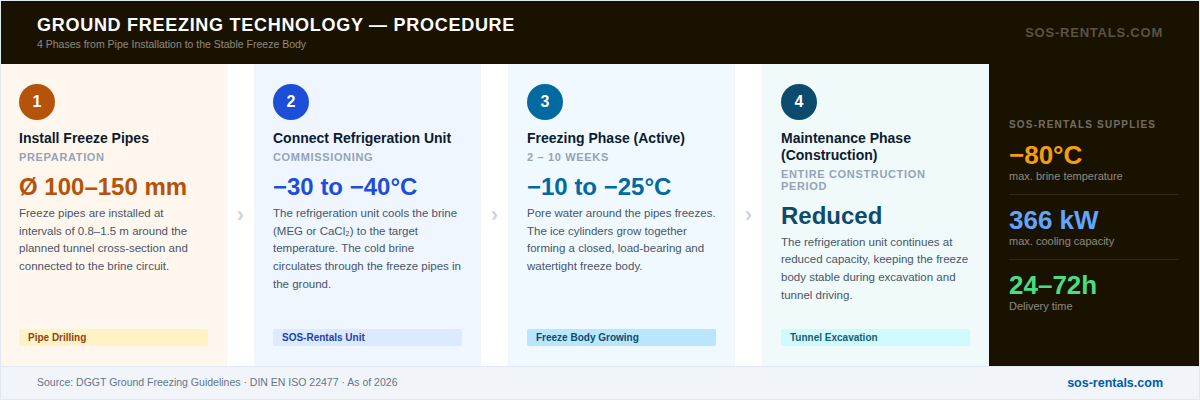
In the ground-source cooling process, cooling pipes (Ø 100–150 mm) are buried in the ground. A refrigeration unit cools a brine solution (typically calcium chloride) to between −25°C and −40°C. The brine circulates through the pipes and extracts heat from the ground. The pore water freezes, and the ground becomes a load-bearing, water-impermeable ice vault — known as the frozen body.
The 4 steps of the freezing process
- Install frost protection pipes — at intervals of 0.8–1.5 m around the cross-section
- Connecting the refrigeration unit — Connecting the brine pipes to the evaporator tubes
- Freezing phase (active) — The refrigeration unit runs for weeks or months until the target temperature is reached
- Standby phase (passive) — reduced power consumption keeps the freezer compartment at a stable temperature during the construction period
Where is ground freezing technology used?
This method is used wherever conventional shoring is not possible or is uneconomical.
Tunnel construction beneath groundwater
When constructing underground railway tunnels, railway tunnels and road tunnels below the water table, the freezing method is often the only safe option.
Notable projects: Stuttgart underground station, Hamburg underground extensions, various sections of the Eurotunnel.
Shaft construction in mining
When sinking deep shafts (for coal, salt or potash), the freezing method is used to penetrate aquifers.
Special feature: The shafts reach depths of several hundred metres — the freezer unit must be watertight along its entire length.
Underpasses and crossings
When crossing roads, railway tracks or rivers underground, a frozen tunnel section protects the existing infrastructure and enables the new cross-section to be constructed.
IN STOCK NOW + FAST DELIVERY
Looking for a refrigeration system at short notice?
Our team will get back to you within 24 hours – from 4 kW chillers to
low-temperature systems down to -80 °C
A comparison of refrigerants: brine, methanol, nitrogen
The choice of refrigerant depends on the target temperature, the scale of the project and environmental regulations.
| Coolant | Features & Applications |
| Calcium chloride solution (CaCl₂) | The most tried-and-tested coolant. Temperatures down to −40°C. Non-flammable, cost-effective. Disadvantage: corrosive, not suitable for all pipe materials. |
| Liquid nitrogen (LN₂) | For very rapid freezing of small areas. Extremely cold (−196°C). High costs and logistical requirements — for emergency and spot freezing only. |
Why renting cooling systems makes more economic sense for construction projects
Ground-freezing projects typically last between 2 and 36 months. Purchasing a dedicated refrigeration unit would hardly make economic sense for such a short period.
The benefits of renting refrigeration equipment | What this means for your project |
Acquisition costs | Not applicable at all — no capital tied up |
Delivery time | promptly for cryogenic systems up to 366 kW |
Flexibility | Performance class can be adjusted at any time — more or less cooling capacity |
Maintenance | Fully covered by SOS-Rentals during the hire period |
End of project | Equipment will be collected — no disposal or resale required — no need for machinery |
Documentation | All technical documents for project documentation and regulatory authorities |
💡 For projects lasting less than 36 months, renting cooling equipment is generally more cost-effective than buying it — and this is almost always the case for construction projects.
What SOS-Rentals provides for tunnel construction projects
| Scope of services provided by SOS-Rentals for ground freezing projects: |
| ✔ Low-temperature systems 4–366 kW, brine temperatures down to −40°C |
| ✔ Brine pipes, manifolds and connection kits available on request |
| ✔ Delivery and commissioning by SOS technicians — throughout Europe |
| ✔ Technical support throughout the entire freezing phase |
| ✔ The tenancy period can be extended at short notice |
| ✔ Complete documentation for site management and the authorities |
Frequently Asked Questions: Rental cooling systems in tunnel construction
How long does it take to assemble a freezer unit?
Depending on the soil type, cross-sectional dimensions and groundwater flow, the freezing phase typically lasts from weeks to months. Afterwards, a significantly reduced ‘retaining capacity’ is sufficient to keep the frozen section stable during excavation.
Can several chillers be operated in parallel?
Yes. Where large cross-sections are involved or very rapid freezing is required, several systems are operated in parallel. SOS-Rentals coordinates the simultaneous delivery and commissioning of several units.
What happens if the refrigeration unit breaks down during the freezing phase?
SOS-Rentals responds immediately and repairs the unit as quickly as possible. If necessary, a replacement unit (subject to availability) will be provided. The freezer compartment loses temperature only slowly. The situation becomes critical in the event of a prolonged breakdown during the excavation phase.
Are there any requirements regarding the mains supply on site?
Cryogenic systems typically require 400V three-phase power. SOS-Rentals provides details of the exact connection requirements in advance — to ensure a smooth commissioning process on site.
Does SOS-Rentals also deliver to hard-to-reach building sites?
Yes. SOS-Rentals coordinates special transport operations and is well-equipped to deal with conditions on building sites. Advance information on access routes, crane capacity and storage space helps ensure optimal planning.
Conclusion: Ground-freezing technology requires a reliable cold source — SOS-Rentals provides it
No other construction method places such specific demands on low-temperature cooling as ground freezing technology.
Precise brine temperatures, high operational continuity over a long period, rapid availability and comprehensive project documentation — SOS-Rentals meets precisely these requirements with a fleet of cryogenic rental units available at short notice.
Planning a ground-freezing project? Request a quote now.
Low-temperature systems down to −80°C · 4–366 kW · Free project consultation
☎ +49 2935 / 9690 370 | info@sos-rentals.de | sos-rentals.com/contact