Why is frozen food logistics particularly at risk in summer?
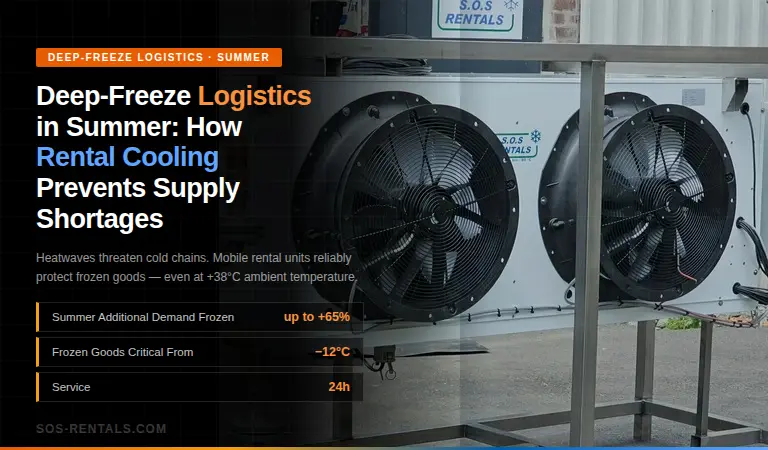
In summer, ambient temperatures rise to +35°C and above — meaning refrigeration systems have to operate at up to 30 per cent higher capacity to maintain target temperatures of ≤−18°C. At the same time, demand for frozen products (ice cream, barbecue food, drinks) rises seasonally by 40–60 per cent. Taken together, these factors lead to a classic capacity bottleneck, which can be bridged by temporary rental refrigeration from SOS-Rentals.
Recent summers have shown what happens when cold-chain logistics come under pressure: supply shortages of ice cream, breakdowns in cold stores, and overheated lorry refrigeration units. Hot summers are becoming more frequent — and with them, the demands on the resilience of the cold chain are increasing.
This article explains the specific risks that arise in summer, how frozen food businesses safeguard their cold chain, and when rental refrigeration becomes a crucial support.
Here’s what you can expect from this article: |
✔ Why frozen food logistics are systematically at risk in summer |
✔ The 4 most critical risk points in the summer cold chain |
✔ Practical solutions: Which rental equipment to use and when |
✔ When to book a portable chiller — timing is crucial |
✔ Checklist: Getting the cold chain ready for summer |
✔ FAQs on summer cold-chain logistics |
The physics behind the problem: Why summer pushes cooling systems to their limits
How do high outdoor temperatures affect deep-freeze systems?
Air chillers and deep-freeze units cool by dissipating heat into the ambient air. At an outside temperature of +35°C, a deep-freeze system must bridge a temperature difference of over 53 Kelvin (from a target temperature of −18°C to an ambient temperature of +35°C). At an outside temperature of +15°C, the difference is only 33 Kelvin. The required compressor capacity increases by 20–40 per cent at high outside temperatures — many existing systems are not designed to handle this load.
The critical summer equation
Factor | Consequence |
Demand for cooling is rising | Summer temperatures: +30 to +40 per cent higher cooling demand than in winter |
Plant efficiency is falling | The compressor’s COP (coefficient of performance) falls by 15–30 per cent at high outdoor temperatures |
Demand is rising | Ice cream, barbecue food, drinks: frozen food sales up 40–60 per cent in summer |
A bottleneck arises | A combination of increased load and peak demand = a classic capacity bottleneck |
Risk of total failure | Overloaded systems are at greater risk of failure in the height of summer (statistics: +35 per cent) |
The 4 most critical risk points in the summer cold chain
Risk 1: Overloading the existing plant
Air-conditioning systems designed for a specific ambient temperature reach their limits when summer temperatures remain consistently high. Symptoms: The compressor runs continuously, the target temperature is no longer reliably achieved, and energy consumption rises dramatically.
⚠ Warning signal: The system is no longer reaching the target temperature |
→ Is the target temperature +2°C or more above the setpoint? Take immediate action. |
→ Is the compressor running continuously without any cooling breaks? Risk of overload. |
→ Is the air coming out of the condenser noticeably hotter than usual? Check the heat exchanger. |
→ Immediate action: Request an additional chiller from SOS-Rentals for support. |
Risk 2: Disruption to the cold chain during transport
Refrigerated lorry units are approved for specific outside temperatures. In extreme heat, loading times (with the door open) can lead to critical rises in temperature. Particularly critical are loading and unloading operations carried out without cooling bridges or in uncooled warehouses.
Risk 3: Cold store capacity bottleneck due to a peak in demand
When sales volumes of frozen products surge in the summer, there is often a shortage of storage capacity. Ready-made products cannot be stored — delivery delays are caused not by production issues, but by a lack of cold storage space.

Risk 4: Failure during the peak season — the most costly time
If the refrigeration system breaks down in July, sales pressure is at its highest. Every hour of production downtime costs money — and, for businesses subject to HACCP requirements, it also poses a regulatory risk. A pre-agreed framework contract for rental refrigeration with SOS-Rentals prevents precisely this scenario.
Practical solutions: Which rental equipment to use and when
| Scenario | SOS-Rentals’ solution |
| Capacity peak (system overloaded) | Parallel chillers: An additional air- or water-cooled chiller takes the load off the existing system. Capacities: 20–500 kW. Installation often completed within 24–48 hours. |
| Cold store capacity bottleneck | Reefer containers: Ready-to-use refrigerated containers (−18°C to −40°C) for temporary storage. Plug-and-play – only requires a power supply. |
| Total failure of the main system | Emergency chillers: Immediate delivery of a replacement chiller. Within 24 hours throughout Germany. SOS-Rentals prioritises emergencies. |
| Outdoor Events & Summer Catering | Air conditioning units and refrigerated trailers for events, festivals and catering events. |
Timing is crucial: when should you book?
Rental cooling systems for the summer should ideally be booked by the end of April to ensure optimum availability and sufficient lead time for installation. Demand and waiting times rise in June and July — those who book early are guaranteed the right system at the best price.
Period | Recommended action |
February–March | Demand planning: Analysis of in-house capacity versus summer forecast |
April (ideal) | Booking rental cooling units: Best availability, best terms, lead time for installation |
May | Set-up & Testing: Installing the system, commissioning it, and integrating it into the HACCP plan |
June–August | Peak season: Plant is operational — capacity reserves and contingency measures in place |
September | Return or extend as required |
Checklist: Getting the cold chain ready for summer
Before the peak season (until the end of April): |
✔ Carry out maintenance on the existing system and clean the condensers (heat exchange efficiency) |
✔ Capacity calculation: Check the system design for an outside temperature of +35°C |
✔ Update the contingency plan: Who should be contacted in the event of a failure? What is the backup solution? |
✔ Sign a framework agreement for rental refrigeration with SOS-Rentals (immediate delivery guaranteed) |
✔ Book reefer containers for peak periods |
FAQ: Frozen food logistics in summer
What is the critical outdoor temperature for air-cooled chillers?
Most standard air chillers are designed to operate at outside temperatures of up to +35°C. If temperatures remain consistently above +35°C, efficiency drops noticeably. SOS-Rentals can advise you on which units are suitable for extreme summer conditions.
Can I use a reefer container as a temporary freezer?
Yes. SOS-Rentals’ reefer containers are ready for immediate use at temperatures ranging from −18°C to −40°C. Plug-and-play: connect to the power supply, set up, and you’re done. Ideal as a temporary cold storage buffer during the summer peak.
Is an annual framework agreement for summer cooling services worth it?
Yes — framework agreements with SOS-Rentals guarantee you priority access, faster response times and, in many cases, better terms. This is particularly recommended for businesses that experience an annual summer peak.
Conclusion: If you plan ahead, you’ll sleep soundly in the summer
Summer cold-chain logistics are not a matter of fate — they can be planned. If you understand the risks, secure refrigeration capacity well in advance and have a reliable refrigeration hire partner behind you, you can keep supply chains stable even at +38°C.
SOS-Rentals recommends: Book your summer cooling hire by the end of April — that way, the system will be installed and commissioned in good time, before the first heatwaves arrive.
Book your rental air conditioning now
Free advice · Fast delivery · Available throughout Germany
☎ +49 2935 / 9690 370 | info@sos-rentals.de | sos-rentals.com/contact