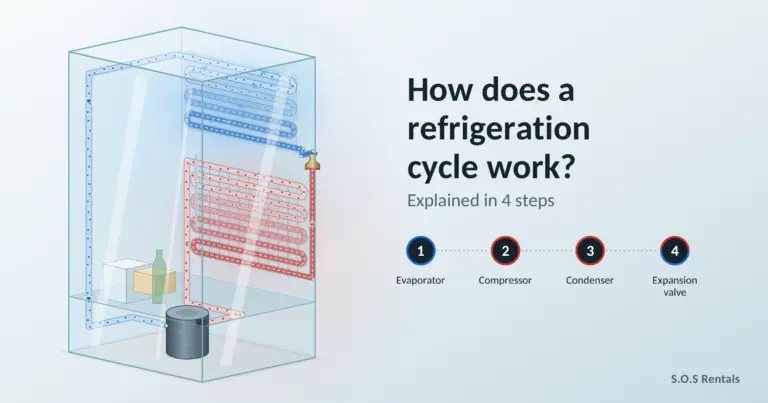
Whether chiller, low-temperature system or refrigerated container – almost every industrial refrigeration system works on the same basic physical principle: the refrigeration cycle. If you understand how this cycle works, you also understand why certain systems are suited to certain temperature ranges, why energy efficiency depends strongly on the operating point, and what matters when choosing the right rental cooling solution.
In this article we explain the classic compression refrigeration cycle in four steps – technically correct, but without unnecessary formulas.
The basic principle: cold is not produced, heat is transported
A widespread misconception: a refrigeration system “produces cold”. Physically, the opposite is true – a refrigeration system removes heat from a room or medium and transports it to the outside. “Cold” is ultimately just the absence of heat. This heat transport is made possible by a refrigerant that changes between two states of matter in the circuit – liquid and gaseous – and absorbs or releases heat at precisely defined points.
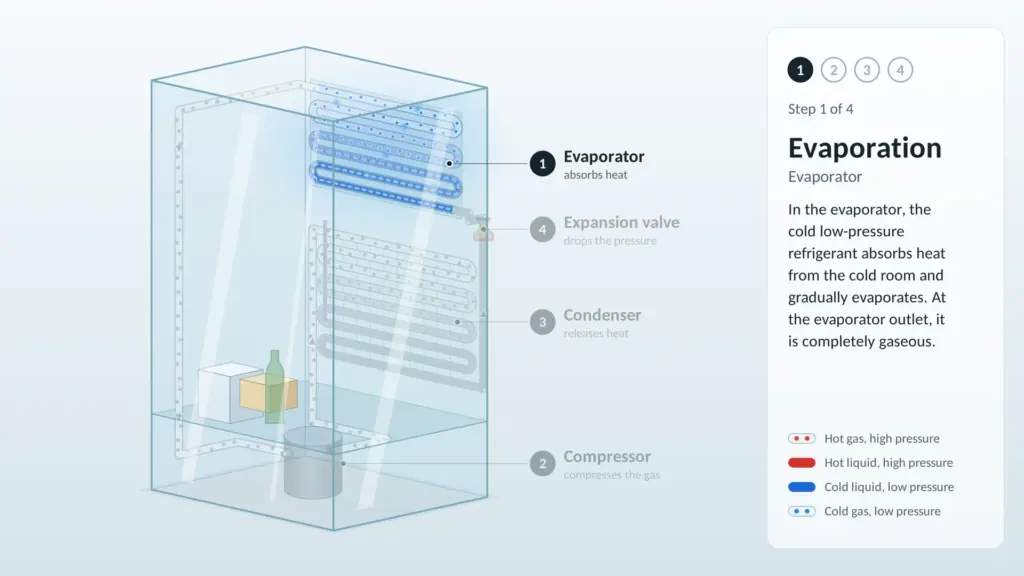
Four components each take on one task: evaporator, compressor, condenser and expansion valve. Together they form a closed circuit that the refrigerant passes through again and again.

Step 1: Evaporation – heat absorption in the cold room
In the evaporator, the refrigerant is liquid and at low pressure. At this pressure it has a very low boiling point – lower than the temperature of the environment to be cooled (e.g. the air in a cold room or the water in a process cooling circuit).
Because the refrigerant is colder than its surroundings, it absorbs heat and begins to evaporate. It is precisely this evaporation process that removes the required amount of heat from the room or medium – this is the actual “cooling effect”. At the end of the evaporator, the refrigerant is completely gaseous.
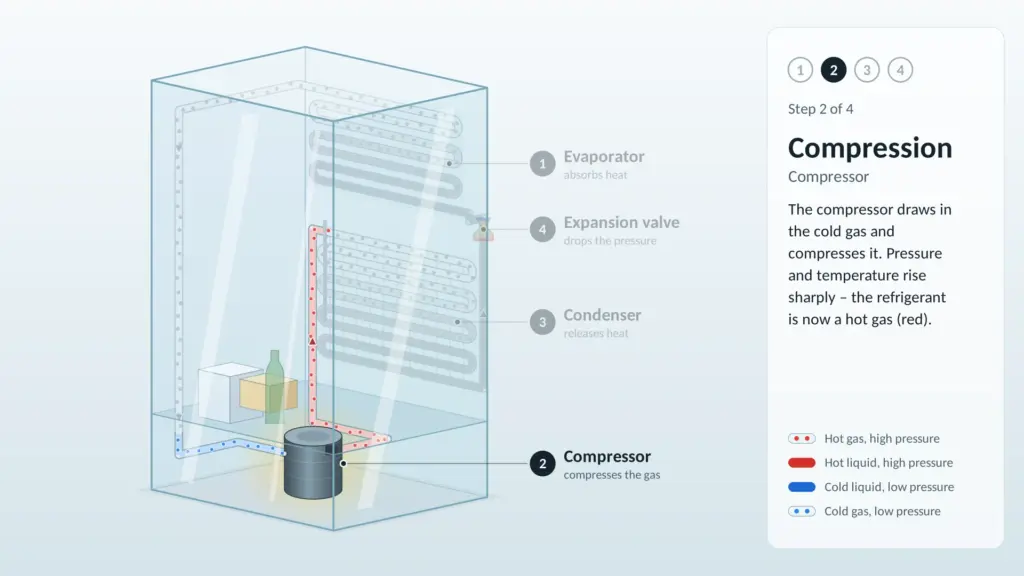
Step 2: Compression – rise in pressure and temperature
The now gaseous but still cold refrigerant enters the compressor. The compressor compresses the gas mechanically, causing pressure and temperature to rise significantly. The compressor is the only component in the classic cycle that actively requires electrical energy – and therefore the main factor in the power consumption of a refrigeration system.
After compression, a hot, highly compressed refrigerant gas is present, which is now ready to release the heat it has absorbed.
Step 3: Condensation – heat release to the environment
In the condenser, the hot, compressed refrigerant gas releases its heat to the environment – depending on the design, to the outside air (air-cooled chillers) or to a water circuit (water-cooled systems). By releasing heat, the refrigerant cools and condenses back into the liquid state, but remains at high pressure.
The heat released in the condenser is, incidentally, the same heat that was previously absorbed from the cold room in the evaporator – plus the additional energy introduced by the compressor.

Step 4: Expansion – pressure drop at the expansion valve
The liquid refrigerant, still under high pressure, now passes through the expansion valve. Here the pressure drops abruptly. With the pressure drop, the temperature also falls significantly – the refrigerant is then cold and at low pressure, exactly the initial state of step 1.
The cycle begins anew: the cold, liquid refrigerant flows back into the evaporator and absorbs heat again.

AVAILABLE IMMEDIATELY + FAST DELIVERY
Need a cooling system at short notice?
Our team will advise you within 24 hours – from a 4 kW chiller to a low-temperature system down to −80 °C
The refrigeration cycle at a glance
- Cold gas, low pressure
- Hot gas, high pressure
- Hot liquid, high pressure
- Cold liquid, low pressure
What does this have to do with the coefficient of performance (COP)?
The coefficient of performance (COP) describes the ratio between the cooling capacity achieved and the electrical power used by the compressor. A COP of 3 means, in simplified terms: for every 1 kW of electrical power used, 3 kW of cooling capacity are delivered.
The COP is not a fixed device constant but depends strongly on the operating point – in particular on the temperature difference the cycle has to bridge. The greater the gap between the temperature in the evaporator and the temperature in the condenser, the more compression work is required and the lower the COP tends to be. This is also the technical reason why low-temperature applications (see our article on low-temperature systems from −15 °C to −80 °C) are more energy-intensive than standard cooling in the positive temperature range – and why, beyond certain temperature differences, two-stage compression or cascade technology is used to keep the COP within an economically sensible range.
Which refrigerants are used in practice?
Im Primärkreislauf werden je nach Anlagentyp, Zieltemperatur und regulatorischen Vorgaben unterschiedliche Kältemittel eingesetzt. Ein grober Überblick:
- Synthetic refrigerants (e.g. R134a, R449A): Widely used in standard chillers and well researched, but increasingly regulated under the European F-Gas Regulation – the trend is towards refrigerants with a lower global warming potential (GWP).
- Natural refrigerants (e.g. ammonia NH3, CO2/R744): Used mainly in larger industrial systems, with very low or no direct global warming potential, but requiring special safety measures (ammonia is toxic, CO2 systems operate at high pressures).
Welches Kältemittel in einer konkreten SOS-Rentals-Mietanlage zum Einsatz kommt, hängt von Anlagentyp und Einsatzbereich ab und wird im Rahmen der technischen Abstimmung transparent kommuniziert.
Why faults can often be traced to exactly these four components
Das Verständnis des Kreislaufs hilft nicht nur bei der Auswahl, sondern auch beim Verständnis typischer Störungsmeldungen:
- Probleme am Verdampfer äußern sich häufig durch unzureichende Kühlleistung bei gleichzeitig normal laufendem Verdichter – oft ein Hinweis auf zu wenig Kältemittel oder eine vereiste Oberfläche.
- Probleme am Verdichter zeigen sich meist durch ungewöhnliche Geräusche, Leistungseinbrüche oder Sicherheitsabschaltungen aufgrund zu hoher Drücke oder Temperaturen.
- Probleme am Kondensator äußern sich häufig durch einen insgesamt ineffizienten Betrieb, da die Wärme nicht ausreichend abgeführt werden kann – etwa bei verschmutzten Lamellen oder unzureichender Luft-/Wasserzirkulation.
- Probleme am Expansionsventil zeigen sich oft durch stark schwankende Temperaturen oder eine Anlage, die nicht die erwartete Endtemperatur erreicht.
Auch wenn die eigentliche Diagnose und Reparatur Fachpersonal vorbehalten bleibt, hilft dieses Grundverständnis dabei, eine Störung gegenüber dem Wartungsdienst präziser zu beschreiben – das beschleunigt die Fehlersuche im Ernstfall.
From theory to the right rental solution
SOS-Rentals plant für Sie die passende Kälteanlage auf Basis Ihrer tatsächlichen Anforderungen – Wärmelast, Zieltemperatur, Medium und Einsatzdauer – statt Ihnen pauschal eine Standardlösung anzubieten. Unser Team berät Sie zur passenden Gerätekategorie, ganz gleich ob Standard-Kaltwassersatz oder Tieftemperaturanlage.
Talk to us about your specific cooling needs.
→ Request a Quote | ☎ +49 2935 9690 370 | info@sos-rentals.com